
By Vinh Hua
San Francisco is currently the site of a number of major battles over gentrification, as residents, developers, tech companies, tech professionals, and landlords fight for their interests in both the court of law and public opinion.
San Francisco has become the most expensive city to live in the United States, even beating out Manhattan. The city has skyrocketing rents, as the growth of the tech-sector creates a burgeoning population of well-paid tech-sector employees. These professionals have driven demand for rental units through the roof, with rental prices soon following. A perfect storm of limited housing stock, market pressures, and transportation improvements allowing San Francisco neighborhoods to become more accessible to commuters, has made San Francisco the fastest gentrifying city in the United States.
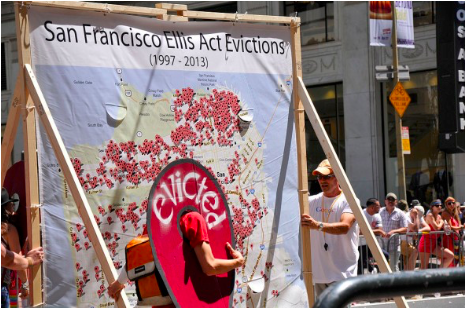
California’s Ellis Act allows owners of rent-control apartment to evict residents if the landlords convert the apartments into condominiums. This has further accelerated the gentrification process, as landlords displace long-term tenants, raise the price of real-estate to take maximum advantage of new residents’ income, and take potential rental units off the market.
Long-term residents, local community organizers, and interested attorneys are trying to fight back. Attorneys have filed lawsuits against landlords, developers, and tech companies using a variety of legal theories and causes of action. Because San Francisco is in such a fast-paced gentrification process, because there are so many legal actions being filed back and forth, and because many of the gentr
ification pressures San Francisco faces are shared with other cities, San Francisco serves as useful microcosm to study gentrification in general. This is especially relevant to places like New York, where factors like the L-train shutdown might exacerbate already existing gentrification pressures.

Below are some of the actions currently being litigated:
AirBnB and other similar companies allow landlords to offer rooms to short term visitors for a premium. As a result, landlords who have available rooms choose to withhold their units from the rental market, instead renting them to tourists and other visitors. This puts pressure on the larger rental market, as less units are available to potential tenants, thereby raising rental prices more generally. Furthermore, it incentivizes landlords to push out tenants when possible to allow for AirBnB rentals. Full-time operators generated more than $43 million for AirBnB in the period between 2014-2015. To address this, San Francisco City council attempted to limit short term rentals to a certain number of days; the measure was defeated in November 2015.
As such, attorneys for long-term tenants have filed a class-action against AIRBnB and one such landlord, alleging that low-income tenants suffered from increased noise and foot traffic, that tenants’ rent was improperly raised, and that tenants were not paid moving expenses. The plaintiffs further allege that AirBnB knowingly enables the landlord to violate state/city housing laws, and knowingly benefits from those violations.
Google and Genetech are two large tech companies with large campuses in the Bay Area. They both provide busing into San Francisco for their employees. This allows Google and Genetech employees to live in San Francisco while commuting elsewhere, creating more demand for rental units in San Francisco proper. This demand leads to the spiking of rental prices, especially along the bus routes.
Busing opponents filed suit against the city of San Francisco and its transit agency for violation of California Environmental Quality Act (CEQA), claiming that environmental review was not done. The California legislature amended CEQA in 2013, as a way of regulating smart growth in San Francisco.
They have further alleged that the buses cause residential displacement. This is the first such lawsuit under CEQA. Where before the CEQA amendment in 2013, socio-economic factors were not factors in a CEQA environmental study, the state must now consider how development may displace residents. CEQA defines displacement as the “the physical removal or elimination of a housing unit.” Though the San Francisco Planning Department argues that displacement under CEQA refers only to the physical destruction of units, plaintiffs argue that gentrification displaces long-term residents and is as destructive to retnal housing.
Other lawsuits allege fraud by landlords. For example, the owner of a building that burned down in San Francisco took out community development loans to rebuild based on an agreement that a certain amount of housing would be low income. Tenants are filing suit to enforce such provisions.
Photo: Demonstrators at SF Pride in 2013 protesting gentrification in San Francisco. “Prideevicted4” by RebeccaBoweSF / CC BY-SA 4.0